
Attic Fan Installer: Cooler Home, Lower Energy Bills
Licensed, insured attic fan installation with a 1-year labor warranty and 468 five-star Google reviews.
Free estimate
Tell us what you need
Three fields. It reaches a person here, not a call centre.
Attic Fan Installation That Actually Performs
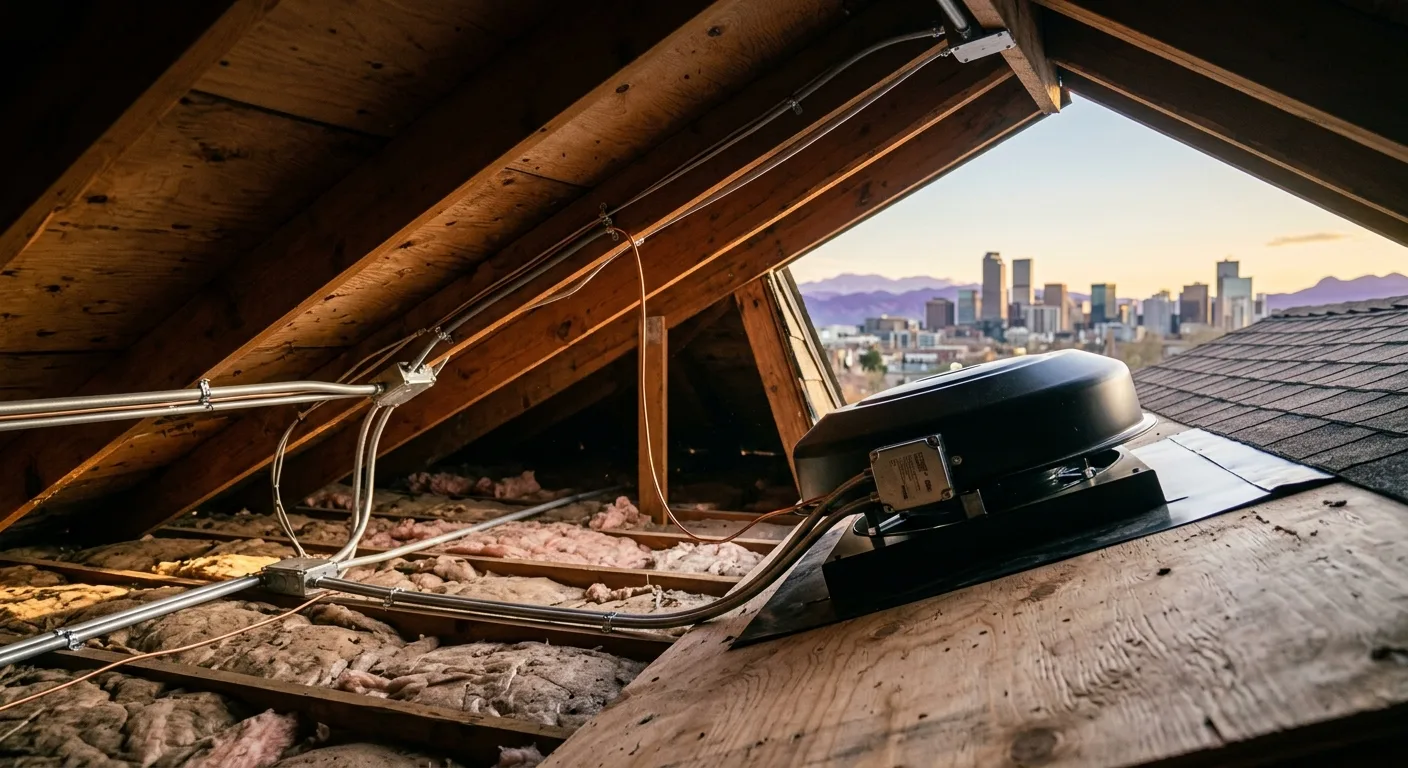
Attic fans are worth installing, but only when the wiring is done correctly. An improperly wired attic fan draws against your HVAC system, cancels out the ventilation benefit, and in the worst cases creates a fire hazard. All Electric handles the full electrical install: dedicated circuit, proper thermostat or humidistat connection, and code-compliant wiring so the fan works the way it's supposed to. CO License #ME.0600978, fully insured, and backed by a 1-year warranty on all labor. Schedule online or call (720) 951-4619 for a free estimate.
The scope and cost of an attic fan install depends on a few key factors: whether your attic already has a usable junction box and wiring path, whether you're adding a thermostat or humidistat controller, and whether the fan is a standard roof-mounted unit or a gable-mounted model. Homes with finished attic spaces or limited access take more time. Attic fan electrical work generally ranges from a straightforward circuit tie-in on one end to running new dedicated wiring with a separate breaker on the other, costs vary accordingly. Every job is different, contact All Electric for an accurate estimate. If you're also weighing options like a whole house surge protector as part of a broader home upgrade, we can address both in a single visit.
What an Attic Fan Does: and What It Doesn't
The Benefits
Five Reasons Homeowners Install Attic Fans
Lower Cooling Costs
By regulating attic temperatures, we reduce the strain on your HVAC system. Your air conditioner won't have to run as long or as hard during summer, most homeowners notice the difference on their utility bill within the first season.
Moisture Control
Excess humidity trapped in an attic leads to mold, rotting decking, and insulation failure. A properly sized fan with a humidistat setting pulls damp air out before it has time to settle, especially important during Front Range shoulder seasons when temperature swings are wide.
Roof Longevity
Heat is hard on shingles from the inside out. Sustained attic temperatures above 140 degrees accelerate shingle degradation and can void manufacturer warranties. Consistent attic ventilation is one of the cheapest ways to protect a roof replacement investment.
Better Air Quality
Stale, hot attic air carries dust, insulation particles, and off-gassing from stored materials. Moving that air out rather than letting it cycle back into living spaces keeps what you breathe cleaner, particularly relevant in older homes with gaps between the attic floor and ceiling drywall.
Year-Round Value
It's not only a summer tool. A fan with a humidistat runs as needed in winter to exhaust moisture from cooking, showers, and daily living, preventing the freeze-thaw condensation cycles that rot roof decking from the inside.
Our Process
How We Handle the Electrical Install
-
Step 1: Site Assessment
We walk the attic, check your panel capacity, identify the cleanest wiring path, and confirm the ventilation math, intake area versus exhaust area, before any work starts. No surprises.
-
Step 2: Dedicated Circuit Wiring
Most attic fans need a dedicated 120V circuit with proper gauge wire and a breaker sized to the unit. We run the circuit, connect the thermostat or humidistat control, and make sure everything is to code and permitted as required.
-
Step 3: Test and Explain
Once the fan is wired and running, we test the thermostat response, confirm airflow, and walk you through the settings. We tell you exactly what was installed, what it does, and what to watch for, no jargon.
What Sets a Proper Electrical Install Apart
Straight from Google
What Our Customers Say
Got the job done well, pleasant to work with.
 Brian NicholsSep 2026 · Google
All Electric is the best! Knowledgeable in fair and troubleshoot till they get the job done, if needed. Highly recommend 🙌🏽
 gina dSep 2026 · Google
Fantastic service. They showed up, assisted in the repairs, found the underlying issues and fixed them and then explained what those issues were in a manner that I could understand. Top service, as always.
 Sean FrohlingAug 2026 · Google
Same day service! Was here in 3 hours. Very honest and charge was kept at the minimum. Polite service as well.
 Fred LudlowAug 2026 · Google
Very responsive. Easy to work with. Would definitely recommend to friends and family.
 BritneyAug 2026 · Google
Electrician came out the next day after calling to install two light fixtures. Minimal issues and got them both installed successfully even though we have an old home. Pricing was reasonable to me. I will definitely be using them again for any similar needs!
 Jillian L. CallaghanAug 2026 · Google
Awesome service. Quick prompt and very professional and knows the business. Daniel Vargas was the Master Tech. Accessed the problem and was quick to diagnose! Two faulty breakers. Highly recommend.
 Michelle BakerAug 2026 · Google
Daniel was great - solution-oriented, super-responsive, knowledgeable and really nice to work with - I will look to Daniel aand All Electric for future needs - thanks!
 Travis BoganAug 2026 · Google
Attic Fan Installation: Common Questions
Not answered here? Call (720) 951-4619 and ask the electrician.
How much does it cost to have someone install an attic fan?
Are attic fans worth installing in Colorado?
Why do some electricians say attic fans cause more problems than they solve?
Does an attic fan installation require a permit in Colorado?
What's the difference between an attic fan and a whole house fan?
Can an attic fan be added to a home that has existing insulation?
Can an attic fan be added to a home that has existing blown-in insulation?
Ready to Install Your Attic Fan?
All Electric handles the full electrical scope, dedicated circuit, thermostat wiring, code-compliant install, and a 1-year labor warranty. 4.9 stars across 468 Google reviews. CO License #ME.0600978.