

Chapter 03 · Circuits & Dedicated Lines
RV Outlets Installed and Repaired by Licensed Electricians
30-amp and 50-amp outlets installed to code, with a 1-year labor warranty on every job.
Free estimate
Tell us what you need
Three fields. It reaches a person here, not a call centre.
RV Outlets: What the Job Actually Requires
RV outlets are not the same as standard household outlets, and plugging the wrong amperage into the wrong receptacle is one of the fastest ways to damage an RV's electrical system. A properly installed RV outlet, whether 30-amp or 50-amp, has to be wired on a dedicated circuit, mounted in a weatherproof enclosure, and matched to the specific load your rig draws. All Electric installs and repairs RV outlets for residential and commercial customers throughout the Front Range. CO License #ME.0600978, fully insured, 1-year labor warranty on every outlet we touch. Call (720) 951-4619 to get it scheduled.
The scope of an RV outlet job varies more than most people expect. A simple 30-amp pedestal replacement at a residential property is a straightforward afternoon job. Running a new dedicated circuit from a main panel to a detached garage or side yard, then installing a weatherproof 50-amp receptacle, takes considerably more work and requires a permit through the local jurisdiction. What drives cost up is distance from the panel, the condition of existing wiring, whether trenching is involved for underground runs, and the amperage level. We won't quote a number without seeing the job. Every job is different, contact All Electric for an accurate estimate.
30-Amp vs. 50-Amp: Choosing the Right RV Outlet
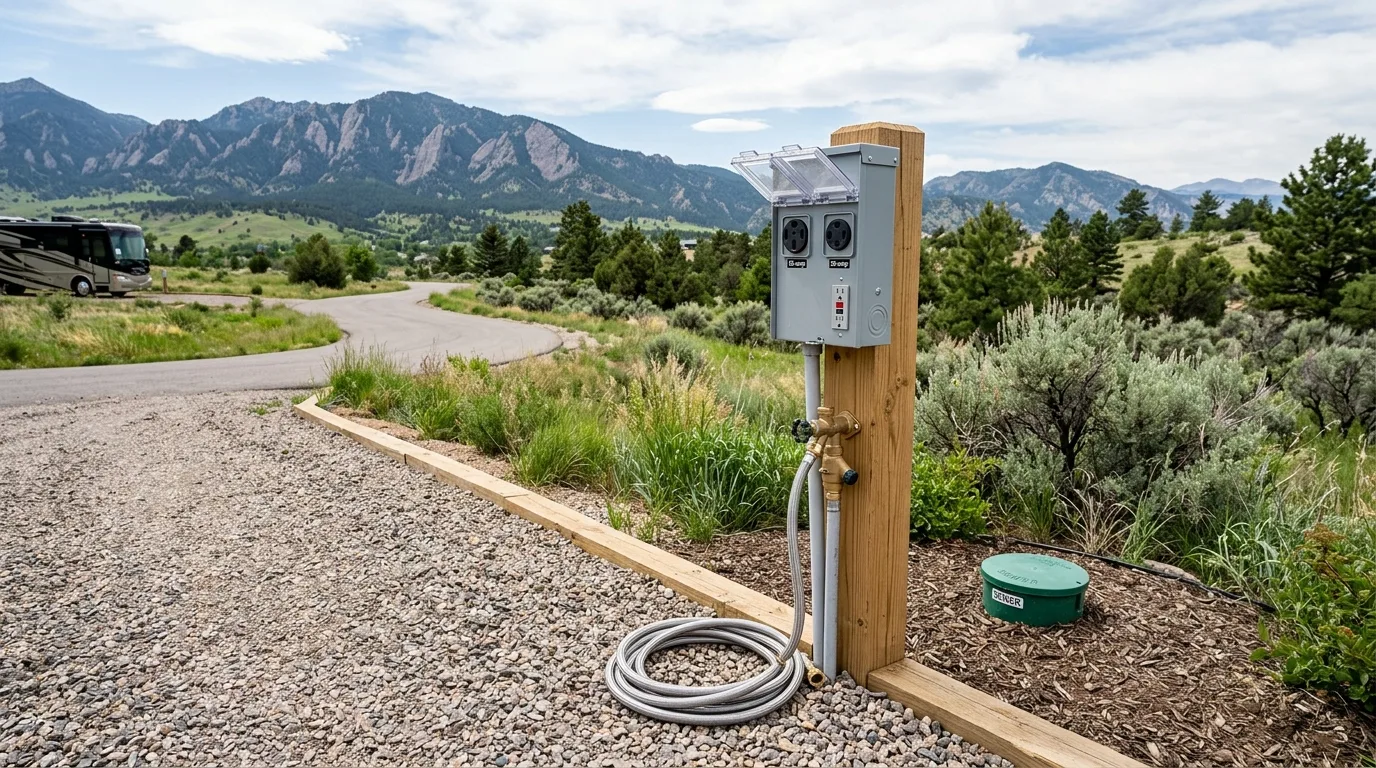
The wrong outlet rating isn't just inconvenient. It can void your RV's warranty and trip breakers under load.
Best Practices
Four Things That Separate a Proper RV Outlet from a Liability
- 01
Match the Outlet to the RV
15-amp, 30-amp, and 50-amp outlets all look similar from a distance but are wired entirely differently. We confirm your RV's actual electrical needs before pulling a single wire. Installing the wrong amperage outlet creates a fire risk and won't hold up to an inspection.
- 02
Dedicated Circuit: No Exceptions
An RV outlet shares its circuit with nothing else. Sharing a circuit with a garage light or a workshop outlet means every time that circuit is loaded, your RV's power is affected. We run a dedicated circuit from your main panel directly to the outlet location, permitted and to code.
- 03
Weatherproof Enclosure and Cover
RV outlets live outdoors. The receptacle has to be rated for outdoor use, mounted in a weatherproof box, and protected by a cover rated for wet locations, even when a cord is plugged in. We don't cut corners on enclosures. A covered outlet that leaks water into the receptacle is a shock hazard.
- 04
Surge Protection at the Source
A power surge from a utility event or a neighboring circuit can wipe out an RV's control board in seconds. We'll discuss whether a whole-circuit surge protective device makes sense at your panel. It's a one-time addition that protects an RV worth tens of thousands of dollars.
Our Process
How We Handle an RV Outlet Install
-
Step 1: Site Assessment
We look at your panel capacity, the distance to the install location, and whether any trenching or conduit is needed. That assessment drives the permit application and the material list.
-
Step 2: Permitted Installation
We pull the permit, run the dedicated circuit, mount the weatherproof receptacle, and connect everything to spec. No shortcuts. Every joint, connector, and conduit fitting is done to NEC and local code requirements.
-
Step 3: Load Test Before We Leave
We test the outlet at full voltage with a meter before closing up the work. You'll know the circuit is delivering the correct voltage and that the breaker responds properly before we pack up.
When to Call Instead of DIY
Straight from Google
What Our Customers Say
Got the job done well, pleasant to work with.
 Brian NicholsSep 2026 · Google
All Electric is the best! Knowledgeable in fair and troubleshoot till they get the job done, if needed. Highly recommend 🙌🏽
 gina dSep 2026 · Google
Fantastic service. They showed up, assisted in the repairs, found the underlying issues and fixed them and then explained what those issues were in a manner that I could understand. Top service, as always.
 Sean FrohlingAug 2026 · Google
Same day service! Was here in 3 hours. Very honest and charge was kept at the minimum. Polite service as well.
 Fred LudlowAug 2026 · Google
Very responsive. Easy to work with. Would definitely recommend to friends and family.
 BritneyAug 2026 · Google
Electrician came out the next day after calling to install two light fixtures. Minimal issues and got them both installed successfully even though we have an old home. Pricing was reasonable to me. I will definitely be using them again for any similar needs!
 Jillian L. CallaghanAug 2026 · Google
Awesome service. Quick prompt and very professional and knows the business. Daniel Vargas was the Master Tech. Accessed the problem and was quick to diagnose! Two faulty breakers. Highly recommend.
 Michelle BakerAug 2026 · Google
Daniel was great - solution-oriented, super-responsive, knowledgeable and really nice to work with - I will look to Daniel aand All Electric for future needs - thanks!
 Travis BoganAug 2026 · Google
RV Outlet Installation: Frequently Asked Questions
Not answered here? Call (720) 951-4619 and ask the electrician.
Are RV outlets different from standard house outlets?
Can you replace a camper outlet with a regular household outlet?
Do I need a permit to install an RV outlet at my home?
What size breaker does a 30-amp RV outlet require?
Can a regular GFCI outlet be used in an RV installation?
How do I know if my existing RV outlet is wired correctly?
Schedule Your RV Outlet Install
Licensed, insured, and ready to get your RV outlet installed to code.