
Chapter 03 · Circuits & Dedicated Lines
RV Outlets Installed Right to Code, Every Time
Licensed, insured, and backed by 468 five-star reviews across the Front Range.
Free estimate
Tell us what you need
Three fields. It reaches a person here, not a call centre.
RV Outlet and Installation Options Explained
Plugging your RV into a standard household outlet isn't just inadequate. It's a fire risk. A proper RV outlet installation means a dedicated circuit sized for your rig, wired by a licensed electrician who pulls the permit and knows what Colorado code requires. All Electric has handled RV outlet installs for nine years, and every job comes with a one-year labor warranty. CO License #ME.0600978. Call (720) 951-4619 to get yours scheduled.
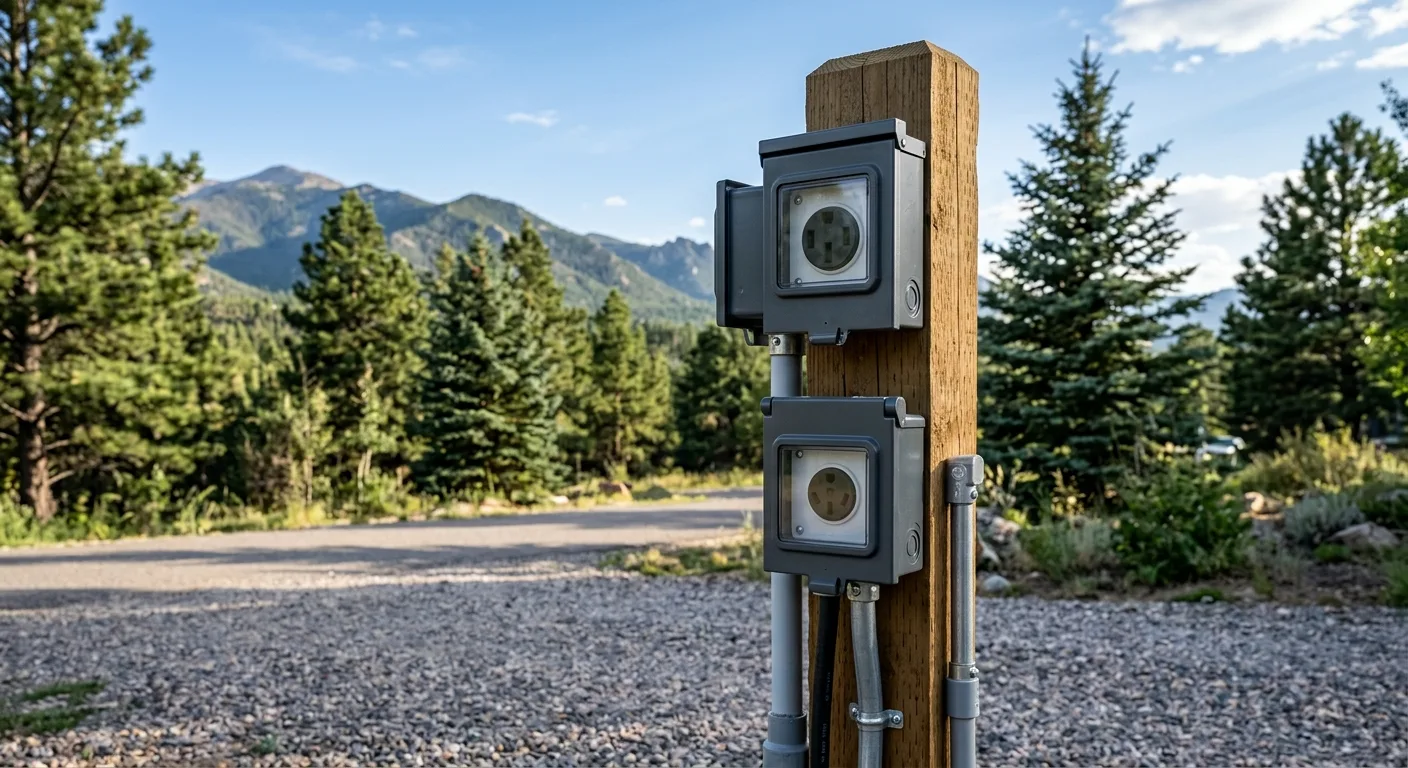
The type of outlet your RV needs depends on what you're powering. Most smaller rigs run on a 30-amp, 120-volt circuit, three prongs, one hot, one neutral, one ground. Larger Class A motorhomes and fifth wheels typically need a 50-amp, 240-volt circuit, four prongs, two hot, one neutral, one ground. Those aren't interchangeable, and the circuit has to match the rig. What drives cost on a job like this: the distance from your panel to the install location, whether your panel has capacity or needs a panel upgrade, how much wall or conduit work is involved, and local permit fees. Every job is different, contact All Electric for an accurate estimate.
30-Amp vs. 50-Amp: Which Outlet Does Your RV Need?
30-Amp (TT-30) Outlet
Three prongs: one hot, one neutral, one ground. Runs on a single 120-volt leg. Standard for most travel trailers, pop-ups, and smaller Class C motorhomes. Needs a dedicated 30-amp breaker. Don't run this on a shared circuit.
50-Amp (NEMA 14-50) Outlet
Four prongs: two hot legs, one neutral, one ground. Delivers up to 240 volts across two 50-amp legs, effectively 100 amps of usable power. Required for most Class A motorhomes, large fifth wheels, and any RV with dual air conditioners.
Dedicated Circuit Requirement
Either outlet needs its own breaker in your panel. Sharing a circuit with a dryer, range, or any other load is a code violation. If your panel is already full, that's part of the conversation before we start.
Adaptor Chains Are a Workaround, Not a Solution
A 50-amp RV running on a 30-amp adaptor can't use its full load, fine short-term, genuinely risky long-term. A permanent install sized to your rig is the fix. We wire it to code and leave you with documentation for your permit file.
How We Work
How RV Outlet Installation Works
Every install follows the same sequence, no shortcuts, no skipped permits.
-
Step 1: Assess Your Panel and Location
We check your panel's available capacity, confirm the right circuit size for your RV, and mark the outlet location, driveway, garage wall, or dedicated parking pad. If the panel needs room, we tell you before we start.
-
Step 2: Run the Circuit and Install the Outlet
We pull the wire from the breaker panel to the outlet box, secure connections properly, install the weatherproof outlet housing, and connect everything to code. For outdoor installs, that means GFCI protection and a cover rated for wet locations.
-
Step 3: Permit, Test, and Hand Off
We pull the permit, schedule the inspection if required, and test the outlet under load before we leave. You get a working RV hookup, a signed permit, and a one-year warranty on our labor.
Common Questions
What Homeowners Ask About RV Outlets
Not answered here? Call (720) 951-4619 and ask the electrician.
Can I just plug my RV into a regular house outlet?
Can you replace an RV outlet with a regular outlet?
How many 50-amp RV outlets can I run on a 200-amp service?
Can I plug my RV into a 220-volt outlet?
Does RV outlet installation require a permit?
What if my electrical panel is already full?
Does adding an RV outlet require pulling a permit?
What wire gauge is required for a 50-amp RV outlet?
What if my panel doesn't have room for a new breaker?
Quick Facts: RV Outlet Specs That Matter
Reference this before you call. It'll make the conversation faster.
30-amp outlet: 3 prongs, 120V, one hot leg
Standard for travel trailers and smaller motorhomes. Dedicated circuit required. GFCI protection needed for outdoor installs.
50-amp outlet: 4 prongs, 240V, two hot legs
Required for large Class A, fifth wheels, and dual-AC rigs. Delivers up to 12,000 watts. Most demanding install, panel capacity must be confirmed first.
Outdoor housing must be weatherproof
Any RV outlet installed outside needs an in-use rated cover, proper sealing, and GFCI protection per NEC. An indoor-rated outlet mounted on an exterior wall is a code violation.
Wire gauge must match amperage
A 30-amp circuit needs #10 AWG wire minimum. A 50-amp circuit needs #6 AWG. Undersized wire is the failure point. It heats up under load and that's how fires start.
Why homeowners trust us
Why Homeowners Choose All Electric
468 reviews averaging 4.9 stars. Nine years in the trade. One license number you can look up: CO #ME.0600978.
-
CO Licensed
License #ME.0600978, verifiable with the state
Verify with the state -
Fully Insured
Coverage on every job, every day
-
1-Year Labor Warranty
On every outlet and circuit we install
Schedule Your RV Outlet Install
Ready to stop running extension cords and adaptors? Call All Electric and we'll get a proper 30-amp or 50-amp hookup installed at your home.